My Favorite Rappers: Kendrick Lamar Pt. 1

In Hip-Hop today, there are so many new artists hitting the scene every day, that there is such a variety in the different content they release. I wanted to start making a list of my top rappers in the game right now. For the first installation to my list, I am starting with my favorite rapper of any era, Kendrick Lamar.

To start I want to talk about his studio albums. I was first introduced to his music through my older brother in 2012, during my sophomore year of high school. That was when he released his second studio album, first with a major label, “Good Kid M.A.A.D. City”. It received widespread critical acclaim and earned him album of the year at the 2013 BET Hip-Hop awards. One of my favorite songs off the album is “Sing About Me, Dying of Thirst”.

After becoming a fan of his through “Good Kid M.A.A.D. City”, I decided to explore some of his older music. I went back to his first studio album, titled “Section.80”. It was here that I found the song, “Rigamortis” which deserves its own blog post. This song is one of the most technically sound songs I have ever heard, and it is almost impossible to rap along with, due to the fact that his lines constantly take turns that cannot be predicted. To better explain it, one must hear it.
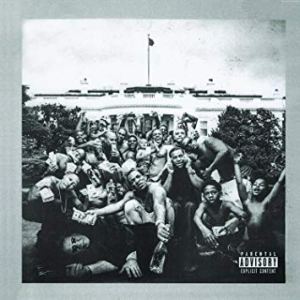
Album Cover for “To Pimp A Butterfly”

Fast forward to 2015, and Lamar released his third studio album, “To Pimp A Butterfly” which featured the single “i” that he had released mid-2014. The album would debut at the number one spot on the Billboard 200 list, and would earn him 5 Grammy’s, including Best Rap Album. This album features two of my favorite songs by Kendrick, “These Walls” and “Complexion”. In this album, he addressed topics such as police brutality and racial tensions in America, and solidified to many his spot as one of the greatest artists in the game right now.
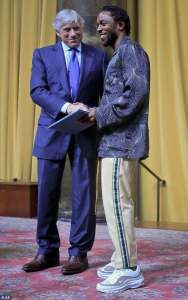
Kendrick Lamar receiving the Pulitzer Prize

In March of 2017, Kendrick released “The Heart Pt. 4” which ended with a tease for a new album to be released the next month. This fourth studio album would be titled “DAMN” and feature the single “Humble”, which would win Best Music Video at the 60th Grammy awards.  This album is unique because it tells two stories. The more well-known story is the one told by playing the album in order from start to finish. However, Lamar confirmed suspicions in an interview that the album can be played backwards to reveal a different story. Eventually he would go on to release a collector’s edition album that had the songs arranged in reverse order. DAMN earned Kendrick five Grammy’s, and the first every Pulitzer Prize for Music awarded to a non-jazz or classical album.

These are all his studio albums to date, but one can assume there is another in the works. In the next installation I will go deeper into his artistic journey from teenage rapper to superstar.

How Hip-Hop Journalism Uses Social Media

In Hip-Hop news and journalism, social media is the main outlet for getting the message out to the masses. One example of this is the yearly XXL Freshman Class list. Although officially announced through the magazine’s website, the link is instantly tweeted out with a few of the names on the list.

The magazine also frequently uses twitter to share its newest interviews and breaking news. They aren’t the only ones to do this though. Another popular news outlet for Hip-Hop and popular culture, HotNewHipHop, also takes to twitter to drop its newest stories and share new music videos.

https://twitter.com/HotNewHipHop/status/1056841823161868289?s=20

One of Hip-Hop’s most iconic radio stations, New York’s Hot 97, even uses twitter to get its platform out. However, Twitter isn’t the only network that Hip-Hop journalists use to receive and publish information. Instagram is also a very big contributor to the breaking news of the Hip-Hop community. This is partially due to the popularity of the Instagram live feature. Many Hip-Hop artists will go on Instagram live to announce news about their music, to follow up on public events, and even possible altercations with other artists. One example of this is with the artist Desiigner. Mostly known for his hit song “Panda”, which has just south of half a billion plays on YouTube, Desiigner took to Instagram live to officially release his song “Outlet” back in 2017.

In recent weeks, no song has gotten more hype and build up around it than Kodak Black’s new song which features Travis Scott and Offset from Migos. First, a video was released that showed Kodak and Travis dancing with some other people to a beat in the studio. It quickly became a viral meme and gained a lot of popularity.

After the popularity of the snipet of the song and beat, Kodak took to Instagram to release a longer video of the beat and him dancing. This made the song even more popular, weeks before its release, and even before anyone knew what the lyrics would sound like. Many Hip-Hop journalists used these video clips to report and investigate who might be on the song and when the song might potentially make its debut.

https://www.youtube.com/watch?v=pyVu29iK4Ys

The social network blog that is probably most well known in the Hip-Hop community is WorldStarHipHop. Started in 2005, the site regularly has fights, music videos, and other youth related content daily. In 2012, BET voted WorldStar as the top Hip-Hop and urban culture website, for the third year in a row.

With social networks growing by the day, and ever connecting our world, it is only right that Hip-Hop journalists are utilizing them to spread Hip-Hop videos, news stories, and tragedies to all corners of the globe.

Holograms in Hip-Hop

Holograms of artists at live concerts is quickly becoming a trend in multiple genres of music, especially Hip-Hop. The history of holograms in Hip-Hop goes back to 2005, when the virtual members of alternative rock/hip-hop band Gorillaz came to life on stage. During their scheduled performance at the 2005 Grammy’s, holograms of the virtual members appeared on stage, joined by Madonna in hologram form, being shortly followed by the live musicians and the real Madonna.

The next time a hologram was used in a live Hip-Hop performance, was in 2012 at Coachella music festival, where Tupac Shakur was brought back to life to perform with Snoop Dogg and Dr. Dre. Tupac was killed in September, 1996, after a boxing match in Las Vegas, NV. The performance at Coachella was made possible by Digital Domain, due to a request from Dr. Dre for a virtual Pac to join him on stage. Although technically not a “hologram”, due to the fact that is was actually a 2-D image that was presented to look 3-D, it was the first time in nearly 16 years that anyone had seen the late Tupac on stage.

To follow up, one year later, two late Hip-Hop artists were brought back to life to grace the stage again. Both happened at the 2013 Rock the Bells concert in Los Angeles, CA. The first was Ol’ Dirty Bastard, of the Wu Tang Clan. The late rapper died of an accidental drug overdose in late 2004.

The other rapper who was brought back to life at the Rock the Bells concert, was Eazy-E, member of N.W.A. and founder of Ruthless Records. Eazy-E was one of the first gangster rappers in LA, and founded legendary group N.W.A. alongside Dr. Dre, Ice Cube, MC Ren, and DJ Yella. Eazy-E was brought on stage during Bone Thugs-N-Harmony’s set.

Another Hip-Hop legend who may have a return in the works is Notorious B.I.G. Biggie’s estate stated in 2016 that a hologram was soon to be in the works to keep his legacy alive. However, two and a half years later, and there has been no word on whether or not this project will ever be brought to life.There have been a few rumors of a newer artist who is said to become a hologram, XXXTentacion. The 20 year old was killed early this summer after visiting a motorcycle shop. Although news on this topic is slim, a short video has been leaked of this hologram.

https://youtu.be/snOexV8g2ks

With advancing technology, there is no limit to which artists will be brought to life next with holograms.

How Social Media Changed Hip-Hop

As of 2018, Hip-Hop has become the most popular genre in the U.S., thanks to social media. To see this journey, we must go back to the “first” viral Hip-Hop song, “Crank That (Soulja Boy)” by Soulja Boy Tell’em.

This debut single was originally uploaded to YouTube in 2007 and gained a lot of traction, eventually peaking at number 1 on the Billboard Hot 100 list. The success of “Crank That” would open the door for other artists to utilize the internet and social media to gain fans and exposure with their music. One artist who would utilize this is Wiz Khalifa. Although having a good following and getting radio time, in 2009, Wiz Khalifa was still a relatively new rapper in the mainstream. Utilizing Twitter, he would interact with fans and collaborate by having producers send him beats. Some of them even made it onto one of his most iconic mixtapes “Kush and Orange Juice”.

Since then, many artists have used social media to collaborate with other artists, communicate with fans, and release new music, so much so that it is almost the norm. One platform that had a big hand in making that switch is SoundCloud. Founded in 2007, it is a platform that allows any artist to independently release their own music without the need for a label. The site is set up in such a way that artists with large followings, and artists with small followings, have the same exposure to those users who have not heard of them. This fair chance makes it so anyone can have a song “blow up” and suddenly their lives are changed forever. One example of an artist who was able to go from unknown, to doing shows internationally, Post Malone.

Post Malone uploaded the song “White Iverson” to SoundCloud in February of 2015, and went to bed. He awoke the next morning a sensation, being mentioned on Twitter by names such as Wiz Khalifa and Mac Miller. From this, was able he to secure a record deal and both of his albums released are multi-platinum.

From left to right, Metro Boomin, Post Malone, and Quavo of Migos, pose with their platinum plaque for the single “Congratulations”

With so many different social media platforms, music can reach people from all over the U.S. and even the world. It has made it so any artist can reach listeners from all over, whether they are a rapper from Philadelphia with an Atlanta sound, or a 16 year old from South Florida. The easily accessible music and the ability to self-promote themselves through social media has launched artists to new heights, and made Hip-Hop the top genre in the U.S.